Posts

Showing posts with the label trends

Women's Birth Rates by Age Group Over Half A Century
Image
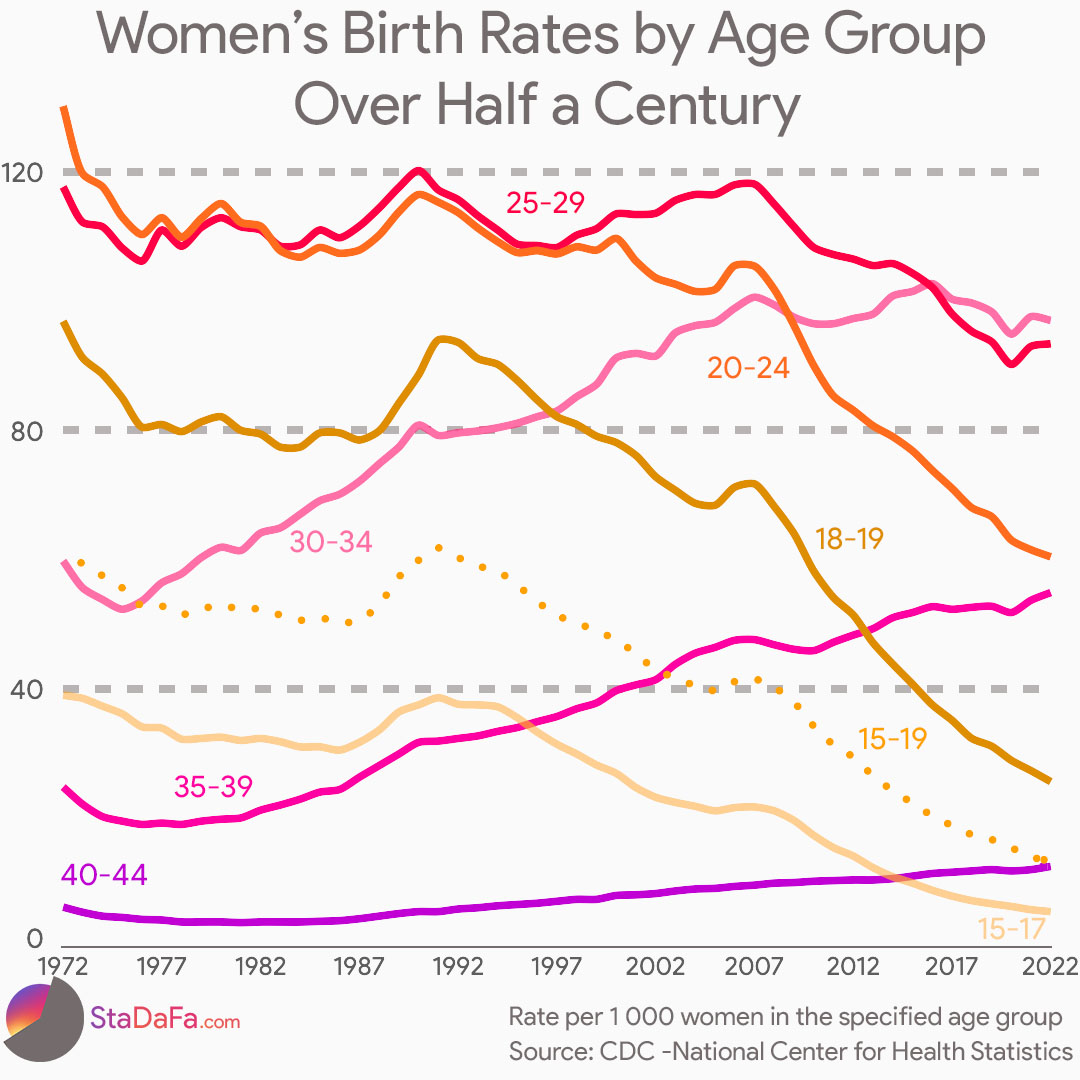
  This week we take a look at Women's Birth Rates by Age Group. In the ever-evolving landscape of demographics and societal trends, birth rates among women have seen remarkable shifts over the years. To shed light on this topic, I've put together a graph depicting the birth rates of women across different age groups. Let's dive into the intriguing findings. The Decline in Teenage Birth Rates: In 2022, the birth rate for teenagers aged 15-19 hit an all-time low, standing at 13.5 births per 1,000 females. This marks a staggering 78.2% decrease from the peak rate of 61.8 births per 1,000 females in 1991. This substantial drop represents an important achievement in public health and education. Young adults are increasingly making informed choices about their reproductive health, emphasizing the importance of sexual education and access to contraception. Age-Specific Trends When we delve deeper into teenage birth rates, the numbers reveal an even more significant transformat...
Share Of University Degrees Going To Women

Image
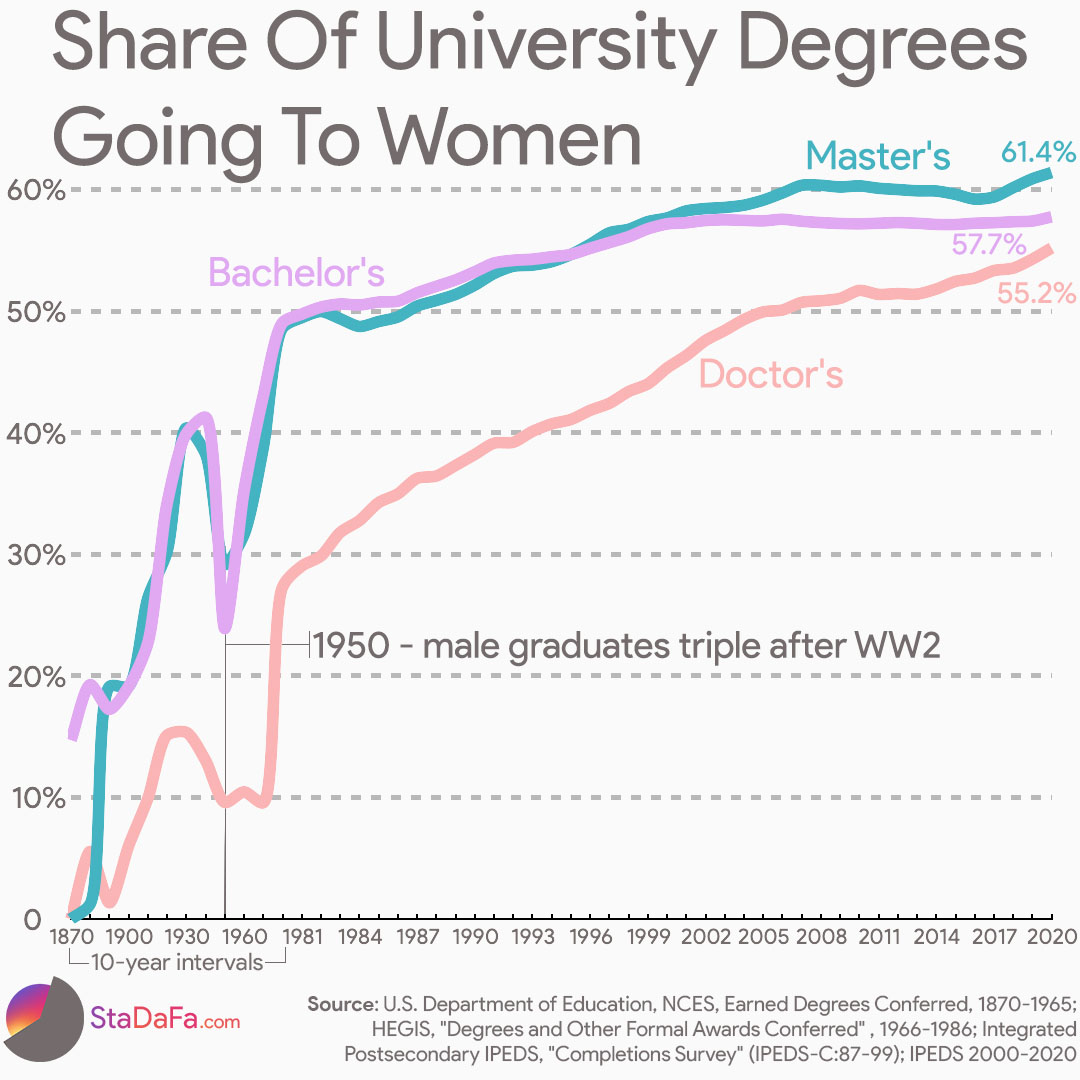
This week we take a look at the share of university degrees going to women. Our data begins in the 1869-1870 school year when 1378 women got a Bachelor's degree ,   and none got either a  Master's or a  Doctor's degree.  Things may look a bit bleak, but it must be taken into account that the numbers for men were 7,993, zero, and 1 respectively. While the numbers for women were low at the time, they began to steadily increase over the years and for the 1939-1940 school year, 76,954 got a Bachelor's, 10,223 got a Master's and 429 got a Doctor's degree. Unfortunately, there is no data available for the years the United States participated in World War II . However, we can compare the number of degrees awarded in 1940 and 1950 to see the difference in both the numbers and the genders of the recipients. In 1940, a total of 186,500 bachelor's degrees were given, with 109,546 going to men and 76,954 going to women.  In 1950, the number of b...

COVID-19 and Search Interest On Google

Image
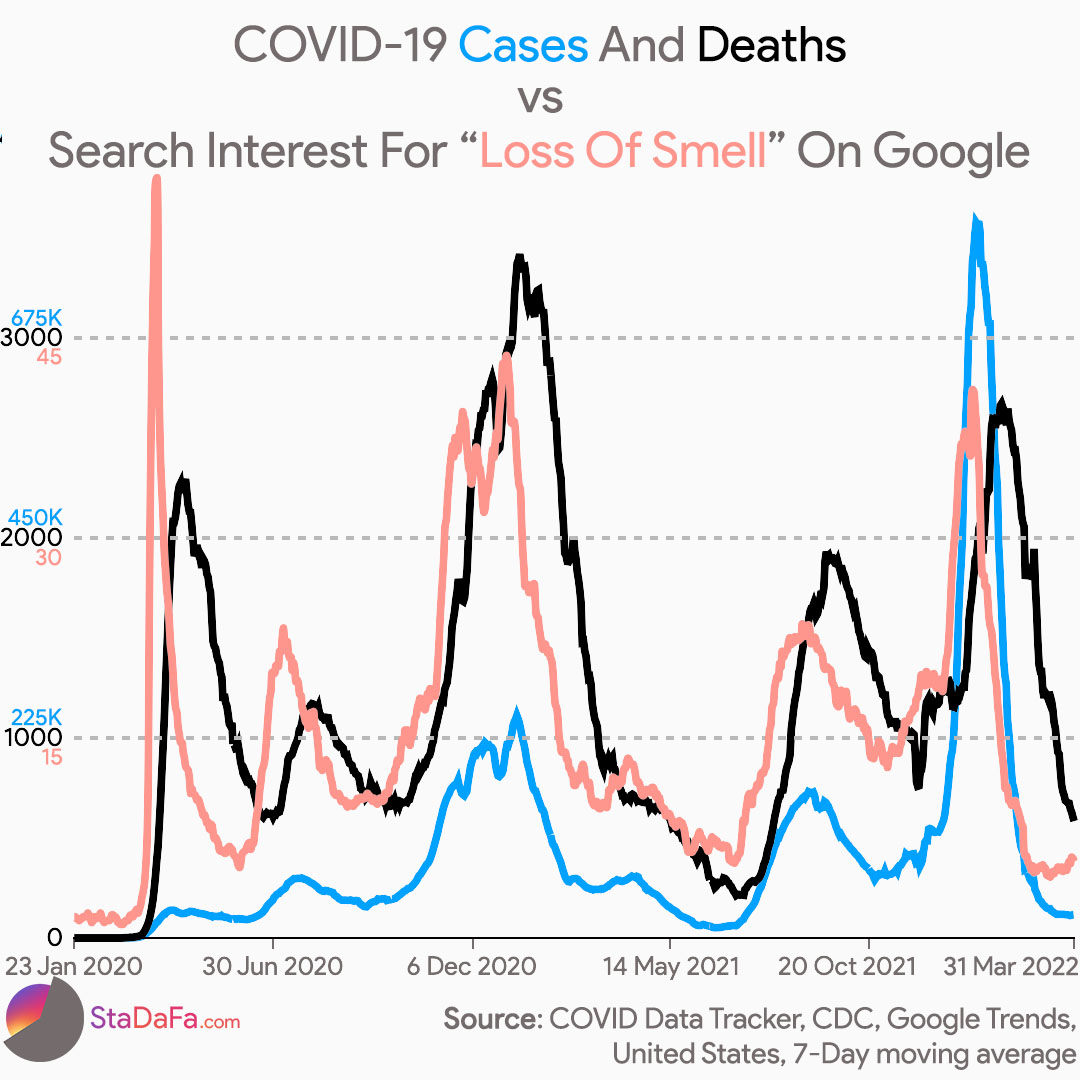
  Anosmia, or the loss of smell, is one of the most common manifestations of COVID-19, and one of the symptoms that differentiates it from other diseases with similar characteristics.  As it is clearly evident in the graph, during the first months of the pandemic when few things about COVID-19 were known and testing was scarce, many individuals noticed the loss of smell and turned to the internet to find out what was wrong. The magnitude of these searches at the end of March 2020, translated a few weeks later to hundreds of deaths.  The story repeated itself many times, throughout all COVID-19 waves. People noticed they couldn't smell, searched it on Google, and then a few days later cases were up, and a few weeks later deaths rose as well.  The average interval between the spikes on Google Search Trends (GST) and Cases is about 9 days, while between GST and Deaths is 18 days. Thus Google search interest can be considered a good indicator of future Covid-19 outbreaks...